
Swiss Academy of Sciences SCNAT
Insights from the Global South for the Revision of the KFPE Guide
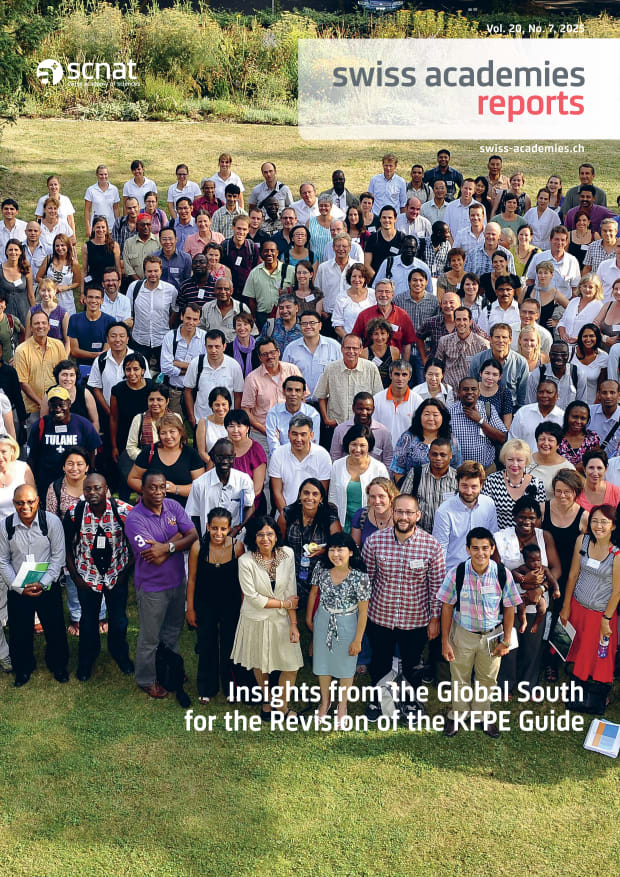
Chi Aye Z, Douangphachanh M, Kaba M, Mwangi J, Nanhthavong V, Frey S, Wiesmann U (2025)
Insights from the Global South for the Revision of the KFPE Guide. Swiss Academies Reports 20 (7)
Swiss Young Academy SYA

Compassionate Science - Integrating Empathy and Compassion in Research
This report explores how empathy and compassion shape research practices across disciplines. Drawing on a review of existing literature and illustrative examples from early-career researchers, it shows that empathy and compassion are not abstract ideals but practical dimensions of research that can influence study design, relationships, data interpretation, and knowledge translation. Across fields, integrating these dimensions can strengthen trust, deepen understanding, improve collaboration, and enhance ethical reflexivity.
Swiss Academies of Arts and Sciences a+

STEM 2026: Where Switzerland stands today
Twelve years on from the first STEM Youth Barometer, the new 2026 edition reveals that interest in STEM has remained largely stable, stereotypes persist, and women underestimate their own abilities. At the same time, the findings are more nuanced than expected and point to clear areas for improvement.
Swiss Academy of Sciences SCNAT

Beyond the transaction: commodity trade and sustainable development
This factsheet maps the sustainability links of commodity trade, identifies knowledge gaps, and outlines options for commodity hubs, including Switzerland, to reduce economic, environmental and social sustainability risks.